


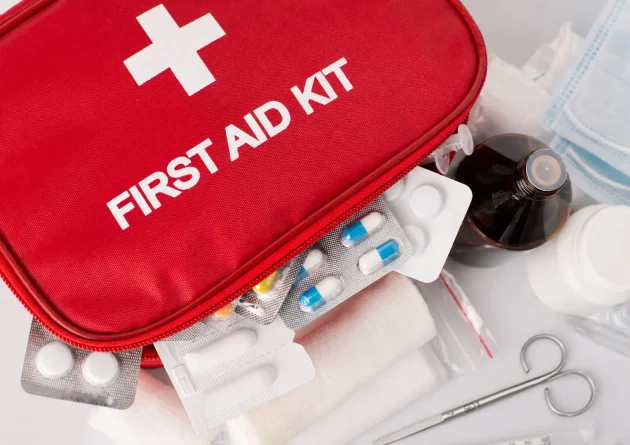

How Are Medical Scissors Different from Regular Household Scissors?
Medical scissors differ from standard household scissors in several important ways. Depending on the model, they may feature angled blades, a rounded blunt safety tip, and micro-serrations that prevent material from slipping while cutting.
This carefully designed construction allows first aid scissors to be slid directly underneath a tight trouser leg, elastic bandage or other material. This makes it possible to cut quickly and with greater control while reducing the risk of accidentally puncturing or cutting the casualty’s skin. A micro-serrated blade also helps grip the material during cutting, making it easier to handle thicker fabrics such as denim, seat belts or leather jackets.
What Are First Aid Scissors Used for in Emergency Care?
First aid scissors are primarily used to quickly expose an injured area by cutting through clothing, as well as for accurately trimming medical tape and other dressing materials.
Instead of spending valuable time carefully removing clothing from an injured person—which can increase pain in the case of fractures or sprains—the material can simply be cut along the seams.
The Most Important Uses of First Aid Scissors
| Emergency use | How does it work in practice? | Why can ordinary household scissors fall short? |
| Quick removal of clothing | Cutting through jackets, jeans or leather clothing around an injury | Sharp tips can accidentally puncture or cut the casualty’s skin |
| Cutting dressings and medical tape | Accurately trimming bandages, gauze and fabric adhesive tape | Standard blades can quickly become covered with adhesive and lose cutting efficiency |
| Cutting seat belts in a vehicle | Freeing passengers trapped inside a vehicle after a collision | Thick materials require greater cutting force and durable, hardened steel |
| Cutting straps and shoelaces | Quickly removing footwear or cutting through thicker materials | Low-quality plastic handles may crack under greater pressure |
Which Medical Scissors Are Available from Renomed?
Before choosing a specific model, it is worth taking a closer look at the complete Dr Cut Medical range. Each pair has been designed with a different application in mind. We discuss individual blade shapes and their intended uses in detail in our article on surgical scissors – types, shapes and applications of medical scissors. Below is a quick overview of all models available in our store.
- MS1 medical scissors – small 11 cm surgical scissors with straight, sharp-sharp blades. Suitable for surgery, dermatology, preventive dentistry and implantology, wherever precise, millimetre-level cutting matters.
- MS2 medical scissors – a compact 10 cm model with straight Spencer-type blades, designed for suture removal during minor dental procedures and maxillofacial surgery.
- MS3 medical scissors – an 11 cm model with curved Spencer-type blades. The curved tip makes it easier to remove sutures accurately, including in harder-to-reach areas.
- MS4 medical scissors – 11 cm scissors with angled, curved sharp-sharp blades, designed to facilitate tissue cutting from different angles and improve access to confined areas.
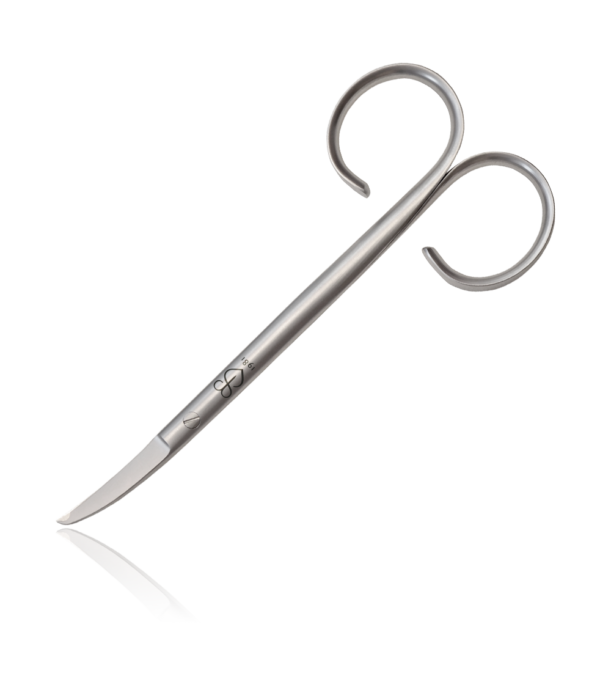
- MS5 SUPER CUT medical scissors – the largest model in the range at 15 cm, featuring two different blades: one smooth and one micro-serrated, together with a safe blunt tip. This model is particularly well suited as first aid kit scissors. The micro-serrations help prevent bandages and dressings from slipping while cutting, while the blunt tip helps reduce the risk of accidentally injuring the casualty.
Which Scissors Should You Choose for a First Aid Kit?
The MS1–MS4 models are professional instruments designed primarily for precise surgical and dental procedures, as well as suture removal. Their usefulness in a home or car first aid kit would therefore be more limited.
For a first aid kit, the MS5 SUPER CUT is the most suitable option. Its micro-serrated blade helps prevent bandages and dressings from slipping during cutting, while the blunt tip helps reduce the risk of injuring the casualty. This is the model we recommend as first aid kit scissors.
How to Choose First Aid Scissors and What Should You Look for?
When choosing scissors for a first aid kit, pay attention to factors such as the length of the arms—typically around 18–19 cm in standard rescue scissors—the material used, preferably AISI 420 stainless steel, corrosion resistance and the size of the polymer handles.
- Standard size (18–19 cm): This is the classic size used for rescue scissors. Longer arms provide greater leverage, so less force is required to cut through thicker materials. This type of model works well in home, office and car first aid kits.
- Compact accessories for outdoor use: For a travel first aid kit or a small EDC bag, mini first aid scissors measuring around 12–14 cm can be a practical choice. They are lightweight and take up little space, although cutting through thick clothing may require slightly more force.
- Durable steel: Make sure the blades are made from stainless steel. High-quality models may also feature an additional protective coating that helps protect the metal against corrosion.
- Large handles: Handles made from a durable composite should have finger loops large enough to allow comfortable use even when wearing thick disposable gloves.


What Mistakes Should You Avoid When Adding Scissors to a First Aid Kit?
The most common mistakes include choosing scissors with sharp tips, buying models made from low-quality materials and storing the scissors at the very bottom of the first aid kit.
- Using scissors with sharp tips: Dressmaking or office scissors can accidentally puncture the casualty’s skin, particularly when working quickly in a stressful situation.
- Choosing the cheapest materials: Poor-quality scissors made from weak materials can bend or break when cutting through a tougher seam.
- Keeping the scissors at the bottom of the kit: Good first aid scissors should be stored near the top or in a separate side pocket so they can be reached immediately when needed.
Choose Your First Aid Scissors Carefully
A reliable cutting tool is an important part of a well-equipped first aid kit and can make emergency assistance easier and faster. Look for durable stainless-steel scissors with safely rounded tips and a design suited to cutting medical materials.
Open your first aid kit, check whether your scissors are easily accessible and, if necessary, replace ordinary household scissors with a purpose-designed medical model. You can also explore all Renomed products to find the model best suited to your needs.
Questions and Answers (FAQ)
Are Scissors in a Car First Aid Kit Required by Law?
In Poland, the contents of car first aid kits are often based on the European DIN 13164 standard, which specifies rescue scissors with a blunt safety tip as part of the kit.
Can Small Scissors Cut Through a Winter Jacket?
High-quality mini scissors made from stainless steel can cut through thick materials, although their shorter length provides less leverage, meaning more force may be required than when using a larger 19 cm model.
How Should First Aid Scissors Be Disinfected and Maintained After Use?
After use, the scissors can be cleaned with an alcohol-based disinfectant, wiped dry and stored in a dry place. In non-clinical settings, autoclave sterilisation is not required if the scissors have only been used to cut bandages.
